That Musty Smell Isn't Going Anywhere: A Florida Homeowner's Playbook for Hiring a Mold Remediation Contractor
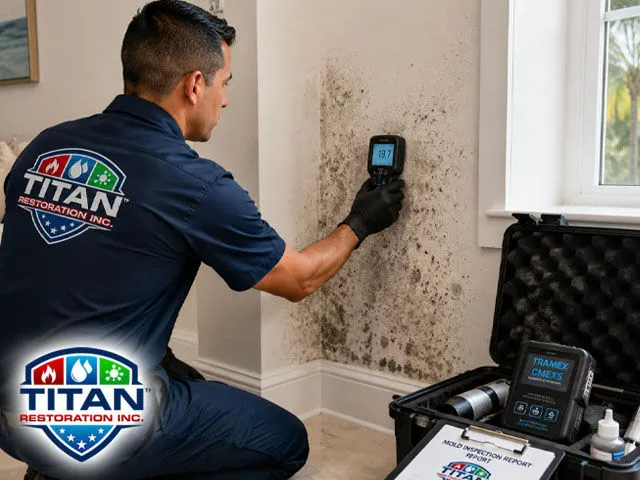
Photo: mold remediation technician in protective suit inspecting wall moisture meter residential home, via static.wixstatic.com
Every Florida homeowner knows the smell. It creeps in behind the guest bathroom toilet, settles into the closet where the AC return never quite reaches, and lingers over that one corner of the lanai. You light a candle. You run the air. The smell stays.
Welcome to the reality of homeownership in the wettest state in the union. Mold in Florida isn't a crisis — it's a maintenance category, like roof shingles and pool chemicals. But the industry that's grown up around it? That's where homeowners actually get hurt. Between scare tactics, five-figure quotes for problems a good scrubbing would solve, and companies that find the mold and then conveniently offer to fix it, the remediation business rewards the unprepared.
Here's how to be prepared.
Florida Actually Has Rules — Use Them
Unlike some states where anyone with a van and a shop vac can call themselves a mold expert, Florida licenses both mold assessors and mold remediators through the Department of Business and Professional Regulation (DBPR). These are two different licenses, and that distinction matters more than almost anything else in this article.
Before anyone sets foot in your attic, ask for their license number and look it up on the DBPR's website. It takes two minutes. A licensed remediator carries insurance, has passed state exams, and has continuing education requirements. A guy with a business card and a moisture meter has none of those things.
One more wrinkle: if the contamination covers less than 10 square feet — roughly a 3-by-3 patch — Florida doesn't require a licensed professional at all. A handyman, or you with proper protective gear and the right cleaner, can handle small surface growth. Contractors sometimes skip mentioning this. You just did the reading.
Never Let the Tester Fix the Problem
This is the single most important sentence in this article: the company that assesses your mold problem should not be the company that remediates it.
It's not a technicality. Florida law actually prohibits it — a mold assessor can't perform remediation on the same job, and vice versa, without jumping through disclosure hoops. The reason is simple economics. If the person diagnosing your problem gets paid when the fix happens, every diagnosis looks like a five-alarm fire.
An independent assessor will take air samples and surface samples, send them to a lab, and hand you a written report with a remediation protocol — what's contaminated, what's the scope, what a proper fix looks like. That report is your shield. Hand it to two or three licensed remediators and ask for bids against the same scope of work. Suddenly you're comparing apples to apples instead of panic to panic.
Yes, it costs a few hundred dollars for the assessment. Consider it the cheapest insurance you'll ever buy against a $15,000 tear-out you didn't need.
What a Legitimate Quote Actually Looks Like
A fair remediation quote is boring. That's the tell. It reads like this:
- Containment setup — plastic sheeting and negative air machines to keep spores from migrating into the rest of the house
- Removal of affected materials — only what's actually non-salvageable, with cut lines specified
- HEPA vacuuming and antimicrobial treatment of remaining surfaces
- Drying and verification — moisture readings confirming materials are back to normal, often with a clearance test from your independent assessor
- Disposal and cleanup — bagged, sealed, and hauled away
What it doesn't include: vague line items like "mold treatment — $8,500," pressure to sign same-day, or dire warnings about your family's health delivered before anyone has taken a sample.
Also be skeptical of the opposite extreme. A quote of $500 to "remove all mold" from a whole-house problem is bait. Either they'll do a surface wipe-down that leaves the colony intact, or the real invoice arrives after your walls are open.
The Questions That Separate Pros From Predators
When the bids come in, ask each contractor:
- Where's the moisture source, and who fixes it? Mold without a fixed leak is a subscription service — it comes back. If nobody's talking about the failed AC drain pan, the roof penetration, or the cracked stucco, keep looking.
- Will you provide a post-remediation clearance report? Reputable remediators welcome third-party verification. Evasive ones dread it.
- What's your containment plan for my HVAC system? Spores travel through ductwork. A pro seals returns and may recommend duct inspection afterward.
- Is this work permitted or documented? Most mold remediation doesn't need a building permit, but the work should still be documented in writing, with photos, for your records — and your insurer's.
That last point matters. If the mold traces back to a covered water event — a burst supply line, a storm-related roof breach — your homeowner's policy may pay for remediation. If it's long-term humidity neglect, it almost certainly won't. Either way, get the claim conversation started before demolition, not after.
The Florida Reality Check
Here in the Sunshine State, the war against mold is fought at the thermostat. Keep indoor humidity below 55%, service your AC annually, and never turn the system off when you travel — even a week of a stalled air handler in July can seed a colony. Snowbirds, this is your annual reminder that a house sitting closed at 85 degrees with the humidity climbing is a petri dish with a mailbox.
And when the smell does show up, resist the urge to call the first company that answers the phone at midnight. Get the independent assessment. Get two bids against the same protocol. Check the licenses. It's less dramatic than a horror story, and in Florida, boring paperwork is usually the difference between a $1,200 fix and a $12,000 regret.
The smell you can't air out? Turns out the cure isn't air freshener. It's a protocol, a clearance test, and a contractor who can explain exactly what they're charging you for.